An IPTV glossary is a comprehensive technical dictionary that defines the protocols, file formats, and hardware interfaces used in digital streaming networks. This guide explains key terms—including M3U playlists, XMLTV program guides, HLS protocols, and multicast routing—providing the necessary context to help users configure streaming players, optimize router settings, and troubleshoot buffering issues.
IPTV Glossary: 50+ Streaming & Network Terms Explained
This iptv glossary is the ultimate reference guide to the dense array of technical abbreviations, network protocols, and hardware interfaces used in modern digital streaming. Setting up an IPTV player or diagnosing stream buffering issues requires a clear understanding of the terms in this reference page.
This comprehensive iptv glossary provides clear, technically precise definitions for the key terminology, standards, and components of digital streaming systems.
Do You Need to Know IPTV Terminology?
Yes, understanding IPTV terminology is essential for configuring streaming players, improving network performance, and fixing setup errors. Having a reliable iptv glossary handy makes it easy to look up these details. Without a curated IPTV dictionary, knowing the difference between an M3U link, an Xtream Codes API login, or a Stalker Portal is difficult, which can lead to black screens or blank channel guides. To understand the underlying network differences, you can read our technical breakdown of IPTV vs OTT.
Furthermore, utilizing this guide to understand network terms like IGMP snooping, CDNs, and VPN throttling helps you optimize your home router settings to eliminate buffering and stream freezes.
Why IPTV Terms Matter
Understanding IPTV terminology helps you troubleshoot common streaming issues, configure your player correctly, and optimize network performance.
Most IPTV errors such as:
- Blank channels
- Buffering
- Missing EPG data
- Login failures
are caused by misconfigured protocols, playlist formats, or network settings — all of which rely on the core definitions listed in this iptv glossary.
Confused by the technical jargon? You don’t need to be a network engineer to enjoy high-quality streaming. Standard IPTV providers require you to manually configure XMLTV paths, parse M3U files, and troubleshoot carrier routing issues. Choosing a managed, pre-configured provider eliminates this complexity entirely. Test a free IPTV trial in Canada to see EPG and channel sync working out of the box.
Tier 1: Formats & Streaming Protocols
In this Tier 1 section of our iptv glossary, we cover the transport protocols, metadata schemas, and playlist specifications used to structure, serialize, and fetch video streams.
M3U (MP3 URL)
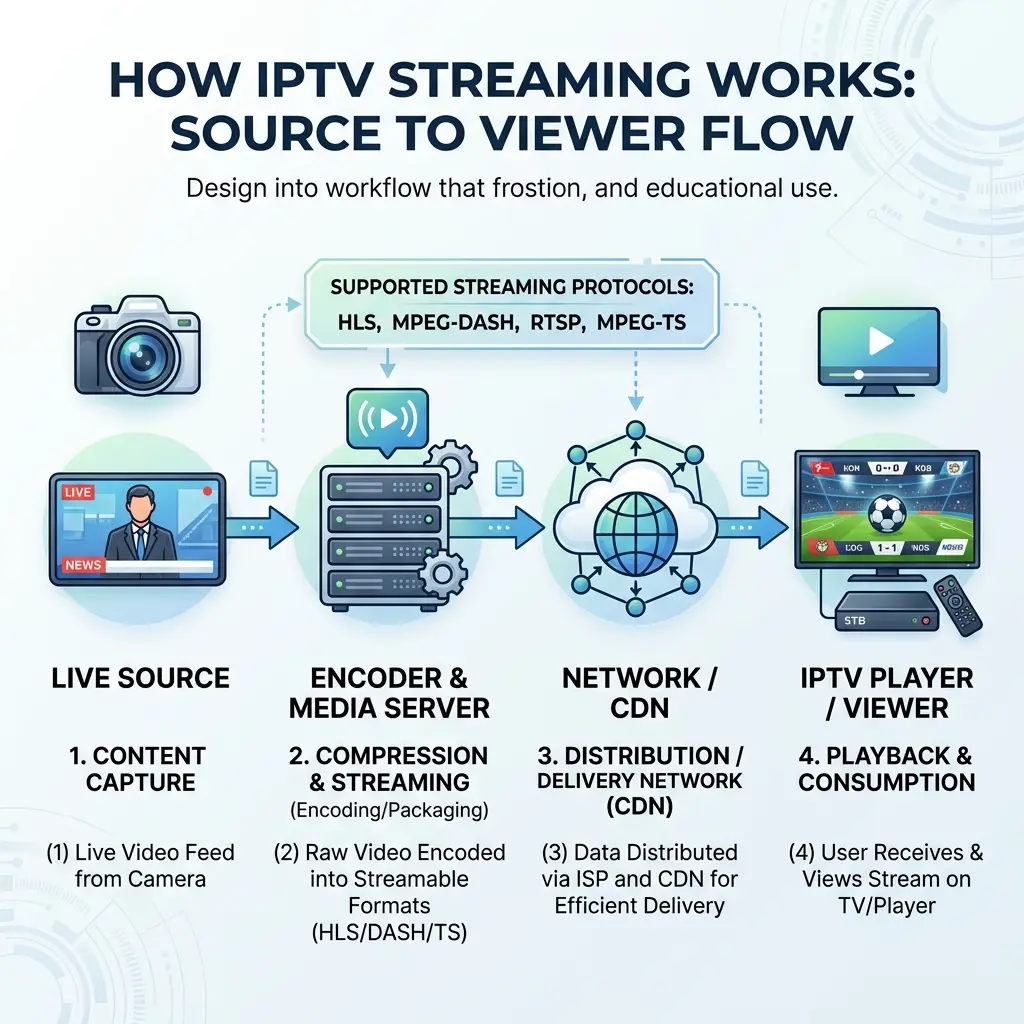
An M3U is a plain-text playlist file that contains a list of media URLs pointing to live streams. It functions as the channel guide map that tells your IPTV player where to find each stream online. For more information on playlist structures, see our guide to the M3U playlist.
M3U8
An M3U8 is a specific M3U playlist file encoded in UTF-8. It is the standard format used by modern web servers and IPTV media players to stream High Definition (HD) audio and video.
Extended M3U Tags
Extended M3U tags are metadata directives that define channel parameters. These directives begin with #EXTM3U and include #EXTINF to specify channel logos (tvg-logo), EPG matching keys (tvg-id), and group names (group-title).
HLS (HTTP Live Streaming)
HTTP Live Streaming (HLS) is an adaptive bitrate streaming protocol developed by Apple that delivers video segments over standard HTTP connections. It splits video into small file chunks (typically 2 to 6 seconds long) indexed in a .m3u8 manifest file.
LL-HLS (Low-Latency HLS)
Low-Latency HLS (LL-HLS) is an extension of the HLS protocol that reduces stream latency to 2–5 seconds. It achieves this by dividing media segments into smaller, sub-second parts that the player can fetch before the full segment is finished.
MPEG-DASH (Dynamic Adaptive Streaming over HTTP)
MPEG-DASH is an XML-based adaptive streaming standard (ISO/IEC 23009-1) that serves video segments over HTTP. It uses a Media Presentation Description (.mpd) manifest to offer a vendor-neutral alternative to Apple HLS.
XMLTV
XMLTV is an XML-based file format used to distribute television schedules. It defines a structured schema (using <channel> and <programme> tags) to represent channel details, show titles, descriptions, and air times, which IPTV players parse to render guide data.
MPEG-TS (MPEG Transport Stream)
MPEG Transport Stream (MPEG-TS) is a digital container format optimized for real-time video transmission over lossy networks. It encapsulates audio and video streams into packet envelopes to facilitate rapid synchronization.
Technical Details (Advanced Networking)
MPEG-TS uses fixed-size 188-byte packets, including a 4-byte header. The header contains a Packet Identifier (PID) to categorize audio, video, and program metadata (Program Map Table or PMT). In UDP IPTV networks, encoders bundle exactly 7 MPEG-TS packets into a single 1,316-byte payload to stay within standard Ethernet Maximum Transmission Unit (MTU) limits without packet fragmentation.
Tier 2: Hardware & Software Players
This Tier 2 section of our iptv glossary lists the physical hardware interfaces and the client-side software applications used to parse playlists, fetch schedules, and decode video streams.
Set-Top Box (STB)
A Set-Top Box (STB) is a physical hardware receiver that connects to a television to decode and render incoming video streams. Dedicated IPTV set-top boxes feature custom hardware decoders for smooth video playback.
MAG Box
A MAG Box is a series of dedicated Linux-based set-top boxes manufactured by Infomir. These boxes rely on physical MAC address authentication and connect directly to server-side Stalker middleware portals to load streams.
Amazon Fire TV / Firestick
An Amazon Fire TV Stick is an Android-based (Fire OS) streaming media player that connects to an HDMI port. It is a highly popular, low-cost client device used to sideload software-based IPTV players.
Nvidia Shield TV
An Nvidia Shield TV is a high-performance Android TV streaming console equipped with a Tegra processor. It supports hardware-accelerated 4K decoding, multi-view streaming, and advanced client-side buffer caching.
SFP GPON Module
An SFP GPON module is a Small Form-factor Pluggable transceiver inserted into a router’s SFP port. It enables direct fiber termination (GPON) into third-party routers, allowing users to bypass provider-issued gateway modems.
TiviMate
TiviMate is a premium IPTV player application designed for Android TV and Fire OS. It features a customizable, grid-based TV guide, support for multiple playlists, and manual EPG channel mapping.
IPTV Smarters Pro
IPTV Smarters Pro is a cross-platform media player application compatible with iOS, Android, Windows, macOS, and Smart TVs. It supports Xtream Codes API logins and M3U playlist imports.
XCIPTV Player
XCIPTV Player is a lightweight media player app for Android devices. It features a clean dashboard interface and utilizes integrated native media players (ExoPlayer and VLC) to ensure stream stability.
VLC Media Player
VLC Media Player is an open-source, cross-platform multimedia player. In IPTV configurations, it is used to play raw streaming links and can import XMLTV guide files via advanced demuxer settings.
Kodi (with PVR IPTV Simple Client)
Kodi is an open-source media player software. It utilizes the PVR IPTV Simple Client add-on to ingest M3U playlists, XMLTV URLs, and catch-up links to display live channels and schedules.
Tier 3: Network & Infrastructure
In this Tier 3 section of our iptv glossary, we examine the physical and logical network components, routing protocols, scaling architectures, and quality metrics required to route video packets.
Delivery Models
IP Multicast
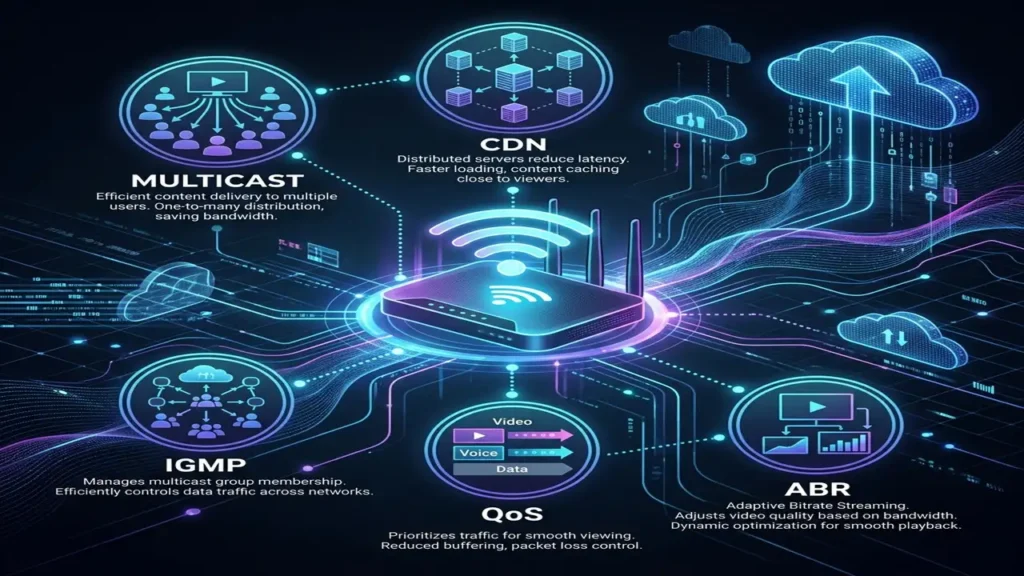
IP Multicast is a bandwidth-efficient network routing method where a source transmits a single copy of a video stream to multiple subscribers. Routers duplicate the packets only at branching junctions where users are active, keeping backbone bandwidth constant (O(1) scaling).
IP Unicast
IP Unicast is a point-to-point delivery model where a dedicated stream is established between the media server and each client device. Aggregate bandwidth scales linearly with the number of viewers (O(N) scaling), requiring extensive CDN networks to prevent bottlenecks.
Network Protocols & Session Routing
IGMP (Internet Group Management Protocol)
Internet Group Management Protocol (IGMP) is a network-layer protocol (IPv4) used by streaming devices and routers to establish multicast group memberships. Client set-top boxes send IGMP Join and Leave commands to switch channels.
RTSP (Real Time Streaming Protocol)
Real Time Streaming Protocol (RTSP) is a network control protocol (RFC 2326) designed to establish and control media playback sessions. In IPTV setups, it acts as a remote control for media servers, managing Video on Demand (VOD) and Catch-up TV streams.
RTP (Real-time Transport Protocol)
Real-time Transport Protocol (RTP) is a transport protocol (RFC 3550) that delivers audio and video packets over UDP. It adds sequence numbers and timestamps to the packets, allowing the receiver to rebuild the media stream and detect packet loss.
HTTP/3 & QUIC
HTTP/3 is the latest version of the Hypertext Transfer Protocol, running over QUIC (Quick UDP Internet Connections) instead of TCP. It eliminates Head-of-Line Blocking and speeds up connection handshakes, making adaptive streams more stable on mobile networks.
WebRTC (Web Real-Time Communication)
WebRTC is an open standard for real-time peer-to-peer data and media streaming. In live streaming, WebRTC is utilized to achieve sub-second latency for interactive broadcasts and live event feeds.
PIM-SSM (Protocol Independent Multicast – Source-Specific Multicast)
PIM-SSM is a multicast routing protocol that builds efficient delivery trees directly from a designated source IP to active client subnets.
Technical Details (Advanced Networking)
PIM-SSM establishes shortest-path trees (SPT) directly between the source (S) and multicast groups (G) using (S, G) routing states. Unlike PIM-Sparse Mode (PIM-SM), it does not require Rendezvous Points (RP) or shared tree (*, G) lookups, reducing path latency and security risks (such as source spoofing) on service provider networks.
IGMP Snooping & IGMP Querier
IGMP Snooping is a Layer 2 switch optimization that listens to IGMP reports to direct multicast streams only to the ports that requested them. The IGMP Querier polls hosts to maintain active multicast group states on the switch.
Anycast & GeoDNS
Anycast and GeoDNS are routing mechanisms used to optimize CDN performance. GeoDNS resolves domains to the closest edge IP based on client subnets, while Anycast shares a single IP address across multiple nodes, routing queries along the shortest BGP path.
GSLB (Global Server Load Balancing)
Global Server Load Balancing (GSLB) is a routing system that dynamically balances traffic across global server nodes based on server health, capacity, and network latency.
QoS (Quality of Service)
Quality of Service (QoS) represents network prioritization techniques (such as VLAN tags and DSCP flags) used by switches and routers to prioritize video packets (DSCP 46) over standard web traffic.
QoE (Quality of Experience)
Quality of Experience (QoE) represents application-layer metrics (such as startup delay, buffer underflow ratio, and video resolution switching rate) that measure the user’s actual streaming experience.
Infrastructure & Hardware
GPON (Gigabit Passive Optical Network)
GPON is a point-to-multipoint optical access network architecture that uses unpowered optical splitters. It delivers downstream capacity (2.488 Gbps) shared among multiple subscribers via dynamic bandwidth allocation.
OLT (Optical Line Terminal)
An Optical Line Terminal (OLT) is the service provider’s central endpoint in a passive optical network (PON). It manages optical signals, schedules upstream transmissions, and routes multicast traffic to ONT devices.
ONT (Optical Network Terminal)
An Optical Network Terminal (ONT) is the customer-premises device that converts optical fiber signals back into Ethernet electrical signals.
DSLAM (Digital Subscriber Line Access Multiplexer)
A DSLAM is a network device located in telephone exchanges that aggregates data traffic from multiple subscriber DSL lines, multiplexing it onto a high-speed core IP network.
VLAN (Virtual Local Area Network)
A Virtual Local Area Network (VLAN) is a logical network partition defined under IEEE 802.1Q. Internet providers segregate standard web traffic (VLAN 35) from managed IPTV traffic (VLAN 36) to prevent domestic bandwidth competition.
CDN (Content Delivery Network)
A Content Delivery Network (CDN) is a globally distributed network of proxy servers. In streaming, CDNs cache media segments at the Edge (close to local ISPs) and aggregate traffic through regional Shield caches to minimize load on the Origin server.
Netflix OCA (Open Connect Appliance)
A Netflix Open Connect Appliance (OCA) is a custom caching appliance deployed directly within ISP data centers to store and serve popular video content locally, reducing backbone transit costs.
DOCSIS (Data Over Cable Service Interface Specification)
DOCSIS is an international telecommunications standard that permits the addition of high-bandwidth data transfer to existing cable television systems, facilitating IPTV-like delivery over HFC networks.
Traffic & Latency Optimization
Adaptive Bitrate Streaming (ABR)
Adaptive Bitrate Streaming (ABR) is a streaming technique where a media player dynamically scales video quality up or down based on real-time network speeds and player buffer levels.
Technical Details (Advanced Networking)
ABR players track network changes by measuring download speeds and monitoring playback buffer states using algorithms like BOLA (Buffer-Based Algorithm). Based on these telemetry metrics, the player requests segments from different resolution/bitrate tiers defined in the server’s encoding ladder.
Video Encoding Ladder
A video encoding ladder is a series of pre-configured resolution and bitrate profiles (ranging from 240p at 300 kbps to 4K at 25 Mbps) that allows ABR players to scale quality up or down during network changes.
Head-of-Line Blocking (HoLB)
Head-of-Line Blocking (HoLB) is a network transport delay where a single lost packet blocks subsequent packet delivery to the application until the lost packet is retransmitted.
Technical Details (Advanced Networking)
HoLB is a major drawback of TCP-based protocols (like HTTP/2 and standard HLS). Modern protocols like HTTP/3 use UDP-based QUIC, which isolates streams so that packet loss in one channel doesn’t block data transmission on other channels.
Maximum Transmission Unit (MTU)
Maximum Transmission Unit (MTU) is the largest size of a data packet that can be transmitted over a network link without fragmentation.
Technical Details (Advanced Networking)
For standard Ethernet links, the MTU is 1500 bytes. To prevent packet fragmentation and transmission latency in UDP-based IPTV streaming, encoders package exactly 7 MPEG-TS packets ($7 \times 188$ bytes) into a single UDP payload of 1316 bytes, staying safely under the 1500-byte IP/Ethernet envelope.
Cache Hit Ratio (CHR)
Cache Hit Ratio (CHR) is a metric measuring CDN caching efficiency, calculated as the ratio of cache hits to total requests. A high CHR (typically >99% for live events) ensures edge servers fulfill requests instead of querying the origin server.
Tier 4: Middleware & Portals
This Tier 4 section of our iptv glossary covers the database systems, session management servers, APIs, and metadata engines that authenticate users and populate the guide interface.
IPTV Middleware
IPTV Middleware is the core software suite that coordinates IPTV operations. It connects user authentication databases, billing platforms, EPG servers, and stream encoders, serving as the backend portal for client applications.
Stalker Middleware (Stalker Portal)
Stalker Middleware is a legacy server-side middleware platform designed by Infomir. It authenticates client devices using physical MAC addresses and serves interactive portals directly to MAG boxes and emulators.
Xtream Codes API
Xtream Codes API is a standardized web service API used to manage IPTV services. It uses username/password authentication and allows players to fetch structured JSON/XML data for live channels, VOD, and EPG tables on-demand.
EPG (Electronic Program Guide)
An Electronic Program Guide (EPG) is the interactive TV guide interface displayed inside your streaming player. It maps channel listings and current/upcoming programs to the stream playlist, allowing users to browse channels chronologically. If your EPG is blank or out of sync, check our complete guide to IPTV EPG setups for troubleshooting.
Time Shift / Timezone Offsets
Time Shift is a configurable parameter offset (e.g., +0000 to -0500) applied to XMLTV timestamps (YYYYMMDDHHMMSS +/-ZZZZ) to align EPG schedules with the client device’s local system time.
Playlist Editors / Aggregators
Playlist editors are middle-tier management tools (e.g., m3u4u.com, xTeVe) used to merge multiple M3U playlists and XMLTV sources, filter channel lists, and map EPG listings before exporting to a player.
Catch-up TV
Catch-up TV is a middleware feature that records live television broadcasts on the server, allowing users to play back previously aired shows via RTSP or HTTP unicast requests.
Setup Tip: If you are constantly running into terminology sync errors like mismatched EPGs or outdated playlist URLs, testing a pre-configured stream feed is the fastest way to isolate the issue. Try a free IPTV trial to check if your player hardware and home network are functioning correctly.
Tier 5: Security & Encryption
This Tier 5 section of our iptv glossary covers the conditional access frameworks, digital rights management platforms, and encryption protocols used to protect streams and restrict access to authorized subscribers.
CAS (Conditional Access System)
A Conditional Access System (CAS) is a hardware-integrated security architecture used in managed broadcast networks. It encrypts streams at the headend and uses Entitlement Control Messages (ECMs) sent to a physical Smart Card or Secure Chip inside the Set-Top Box to authorize descrambling.
DRM (Digital Rights Management)
Digital Rights Management (DRM) is access control software (Widevine, FairPlay, PlayReady) that protects digital content across consumer devices. It manages license keys, restricts playback resolutions, and decrypts content inside secure hardware-backed enclaves.
VPN (Virtual Private Network)
A Virtual Private Network (VPN) is a client-server tunnel that encrypts IP traffic and hides the user’s IP address, protecting privacy and bypassing ISP deep packet inspection (DPI) throttling.
Secure Software Enclaves (TEE)
A Trusted Execution Environment (TEE) is a secure, isolated area of a main processor’s SOC. TEEs isolate key storage and decryption tasks from the main operating system, preventing unauthorized copying of DRM-protected content (e.g., Widevine L1).
Dynamic Token Authentication
Dynamic Token Authentication is a security mechanism where stream URLs are dynamically appended with short-lived cryptographic tokens (hashes). The media server validates the token before initiating playback to prevent stream-ripping and hotlinking.
SSL/TLS Encryption
SSL/TLS Encryption is transport-layer security (HTTPS) that encrypts API payloads (like Xtream Codes responses) and media segments, preventing third-party eavesdropping and credential sniffing.
User-Agent Filtering & IP Whitelisting
User-Agent filtering is a server-side access control method that filters incoming connections based on User-Agent strings and restricts access to approved IP ranges to block unauthorized players and scrapers.