IPTV Glossary: 50+ Streaming & Network Terms Explained
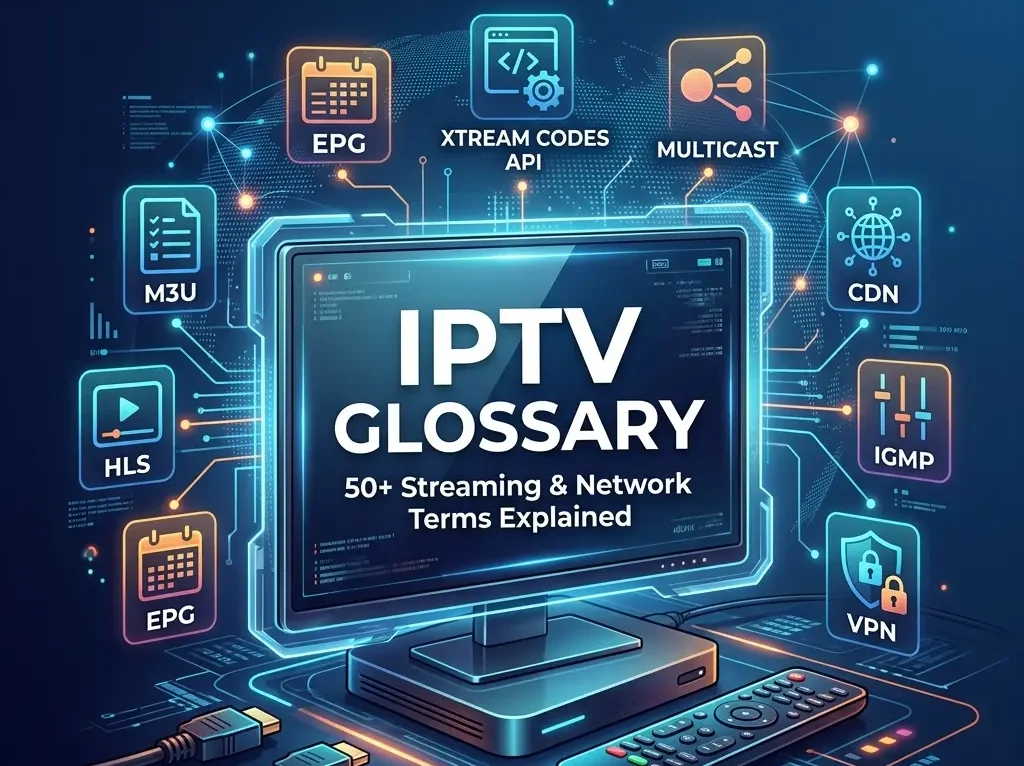
An IPTV glossary is a comprehensive technical dictionary that defines the protocols, file formats, and hardware interfaces used in digital streaming networks. This guide explains key terms—including M3U playlists, XMLTV program guides, HLS protocols, and multicast routing—providing the necessary context to help users configure streaming players, optimize router settings, and troubleshoot buffering issues. IPTV Glossary: 50+ Streaming & Network Terms Explained This iptv glossary is the ultimate reference guide to the dense array of technical abbreviations, network protocols, and hardware interfaces used in modern digital streaming. Setting up an IPTV player or diagnosing stream buffering issues requires a clear understanding of the terms in this reference page. This comprehensive iptv glossary provides clear, technically precise definitions for the key terminology, standards, and components of digital streaming systems. Do You Need to Know IPTV Terminology? Yes, understanding IPTV terminology is essential for configuring streaming players, improving network performance, and fixing setup errors. Having a reliable iptv glossary handy makes it easy to look up these details. Without a curated IPTV dictionary, knowing the difference between an M3U link, an Xtream Codes API login, or a Stalker Portal is difficult, which can lead to black screens or blank channel guides. To understand the underlying network differences, you can read our technical breakdown of IPTV vs OTT. Furthermore, utilizing this guide to understand network terms like IGMP snooping, CDNs, and VPN throttling helps you optimize your home router settings to eliminate buffering and stream freezes. Why IPTV Terms Matter Understanding IPTV terminology helps you troubleshoot common streaming issues, configure your player correctly, and optimize network performance. Most IPTV errors such as: Blank channels Buffering Missing EPG data Login failures are caused by misconfigured protocols, playlist formats, or network settings — all of which rely on the core definitions listed in this iptv glossary. Confused by the technical jargon? You don’t need to be a network engineer to enjoy high-quality streaming. Standard IPTV providers require you to manually configure XMLTV paths, parse M3U files, and troubleshoot carrier routing issues. Choosing a managed, pre-configured provider eliminates this complexity entirely. Test a free IPTV trial in Canada to see EPG and channel sync working out of the box. Tier 1: Formats & Streaming Protocols In this Tier 1 section of our iptv glossary, we cover the transport protocols, metadata schemas, and playlist specifications used to structure, serialize, and fetch video streams. M3U (MP3 URL) An M3U is a plain-text playlist file that contains a list of media URLs pointing to live streams. It functions as the channel guide map that tells your IPTV player where to find each stream online. For more information on playlist structures, see our guide to the M3U playlist. M3U8 An M3U8 is a specific M3U playlist file encoded in UTF-8. It is the standard format used by modern web servers and IPTV media players to stream High Definition (HD) audio and video. Extended M3U Tags Extended M3U tags are metadata directives that define channel parameters. These directives begin with #EXTM3U and include #EXTINF to specify channel logos (tvg-logo), EPG matching keys (tvg-id), and group names (group-title). HLS (HTTP Live Streaming) HTTP Live Streaming (HLS) is an adaptive bitrate streaming protocol developed by Apple that delivers video segments over standard HTTP connections. It splits video into small file chunks (typically 2 to 6 seconds long) indexed in a .m3u8 manifest file. LL-HLS (Low-Latency HLS) Low-Latency HLS (LL-HLS) is an extension of the HLS protocol that reduces stream latency to 2–5 seconds. It achieves this by dividing media segments into smaller, sub-second parts that the player can fetch before the full segment is finished. MPEG-DASH (Dynamic Adaptive Streaming over HTTP) MPEG-DASH is an XML-based adaptive streaming standard (ISO/IEC 23009-1) that serves video segments over HTTP. It uses a Media Presentation Description (.mpd) manifest to offer a vendor-neutral alternative to Apple HLS. XMLTV XMLTV is an XML-based file format used to distribute television schedules. It defines a structured schema (using <channel> and <programme> tags) to represent channel details, show titles, descriptions, and air times, which IPTV players parse to render guide data. MPEG-TS (MPEG Transport Stream) MPEG Transport Stream (MPEG-TS) is a digital container format optimized for real-time video transmission over lossy networks. It encapsulates audio and video streams into packet envelopes to facilitate rapid synchronization. Technical Details (Advanced Networking) MPEG-TS uses fixed-size 188-byte packets, including a 4-byte header. The header contains a Packet Identifier (PID) to categorize audio, video, and program metadata (Program Map Table or PMT). In UDP IPTV networks, encoders bundle exactly 7 MPEG-TS packets into a single 1,316-byte payload to stay within standard Ethernet Maximum Transmission Unit (MTU) limits without packet fragmentation. Tier 2: Hardware & Software Players This Tier 2 section of our iptv glossary lists the physical hardware interfaces and the client-side software applications used to parse playlists, fetch schedules, and decode video streams. Set-Top Box (STB) A Set-Top Box (STB) is a physical hardware receiver that connects to a television to decode and render incoming video streams. Dedicated IPTV set-top boxes feature custom hardware decoders for smooth video playback. MAG Box A MAG Box is a series of dedicated Linux-based set-top boxes manufactured by Infomir. These boxes rely on physical MAC address authentication and connect directly to server-side Stalker middleware portals to load streams. Amazon Fire TV / Firestick An Amazon Fire TV Stick is an Android-based (Fire OS) streaming media player that connects to an HDMI port. It is a highly popular, low-cost client device used to sideload software-based IPTV players. Nvidia Shield TV An Nvidia Shield TV is a high-performance Android TV streaming console equipped with a Tegra processor. It supports hardware-accelerated 4K decoding, multi-view streaming, and advanced client-side buffer caching. SFP GPON Module An SFP GPON module is a Small Form-factor Pluggable transceiver inserted into a router’s SFP port. It enables direct fiber termination (GPON) into third-party routers, allowing users to bypass provider-issued gateway modems. TiviMate TiviMate is a premium IPTV player application designed for Android TV and Fire OS. It features a customizable, grid-based TV guide, support for multiple playlists, and manual EPG channel mapping. IPTV Smarters Pro IPTV Smarters Pro is a cross-platform media player application