Ultimate IPTV Samsung Smart TV Setup Guide 2026
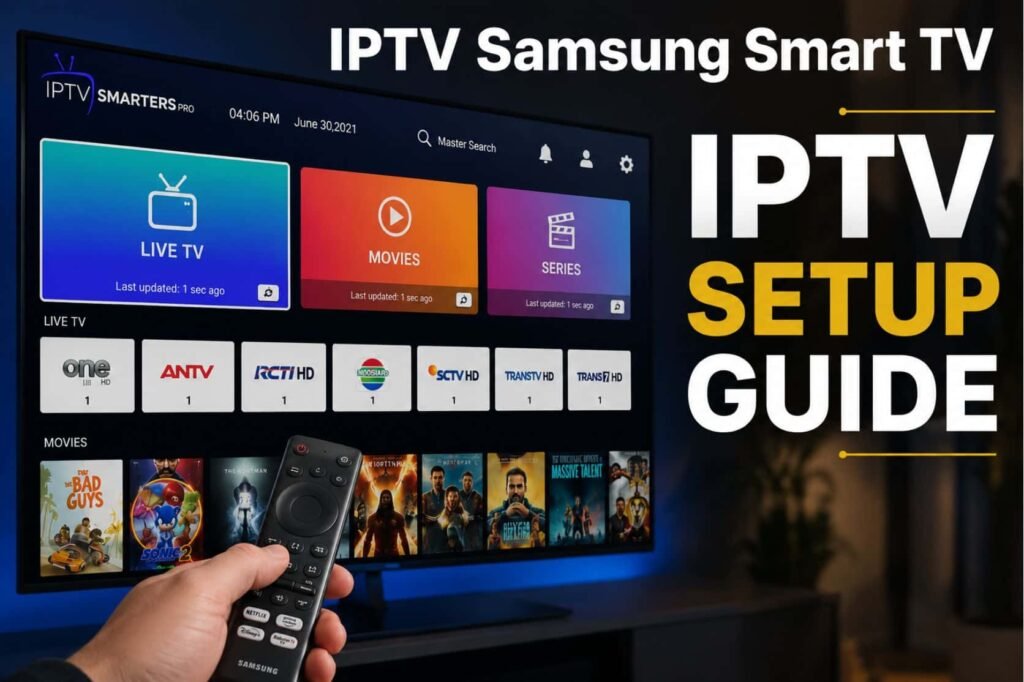
IPTV Samsung Smart TV transforms your living room by allowing you to stream Live TV, Video on Demand (VOD), and Catch-up TV directly through your television’s interface. By leveraging the Samsung Smart Hub and the robust Samsung Tizen OS, you can access global entertainment without needing external hardware like an Android box. Understanding how to watch IPTV Samsung Smart TV is the first step toward a premium viewing experience. IPTV delivers content via HLS streaming protocols over your internet connection, often supporting high-quality formats like 4K UHD and HEVC (H.265). Whether you own a Samsung QLED TV, OLED TV, or a Crystal UHD TV, the setup is straightforward once you choose the right player. Important Disclaimer: Please ensure you only stream licensed, legal content. Using unauthorized IPTV services may violate copyright laws and terms of service. Always prioritize verified providers to ensure a safe and high-quality streaming journey. If you are looking for a reliable service provider to enhance your streaming experience, visit Vibe Viso to explore professional-grade solutions tailored for your television. Is It Possible to Watch IPTV Directly on Your Samsung Smart TV Yes, you can watch IPTV Samsung Smart TV directly, but it depends heavily on your TV’s operating system version and the availability of specific applications within the Samsung Smart Hub. While some models allow a native IPTV setup on Samsung Tizen TV, others may have restricted access to third-party streaming software. Configuring your player correctly is the key to a lag-free experience. If you are struggling with the steps, you can refer to our comprehensive IPTV configuration guide to set up your device perfectly. Additionally, make sure you are using reliable M3U playlists for IPTV to get the best channel selection. The Tizen OS Limitations The primary reason you might struggle to install IPTV app on Samsung Smart TV is the closed nature of the Samsung Tizen OS. Unlike Android TV, which is an open platform, Tizen requires all apps to pass strict security and compatibility reviews to appear in the Samsung Smart Hub. As a result, many popular IPTV players for Samsung Tizen OS are either missing from the official store or have limited functionality. For instance, if you are looking for a specific IPTV player with M3U support, it might be geo-restricted or unavailable in your region, forcing users to seek alternatives to watch IPTV Samsung Smart TV without native support. Understanding Samsung Smart TV Models and Compatibility To know if your device supports an IPTV setup guide, you must first identify your hardware. Generally, Samsung TVs manufactured from 2017 onwards, running Tizen OS 3.0 or higher, offer the best compatibility for IPTV streaming on Samsung Smart TV. How to check your OS: Navigate to Settings > Support > About This TV. Here, you can check your model code and software version. Device Context: Whether you own a Samsung QLED TV, Samsung OLED TV, or a Samsung Crystal UHD TV, the core compatibility remains tied to the Tizen version. The Old TV Factor: If you are trying to configure IPTV on an old Samsung Smart TV (pre-2016 models), you will likely face significant roadblocks. According to documentation on Smart Hub support, older models lack the hardware acceleration required for modern HEVC (H.265) and H.264 codecs, often leading to playback errors or the inability to run modern IPTV apps compatible with Samsung Smart TV. In my 5 years of experience as an IPTV consultant, I have seen many users struggle because they assume every Smart TV can run any application. If your TV lacks the necessary Tizen version, trying to force an installation often leads to a Samsung TV IPTV black screen or an IPTV app that won’t open on Samsung TV. In such cases, attempting a Samsung Smart TV IPTV installation tutorial without the right software version is futile, and moving toward external hardware is the only professional recommendation to ensure a stable 4K UHD or HDR10 stream. What Do You Need Before Setting Up IPTV Samsung Smart TV To ensure a seamless IPTV Samsung Smart TV experience, you must prepare your network and account credentials before beginning the Samsung Smart TV IPTV setup guide. Gathering these essentials prevents common issues like a black screen or playback failed errors, ensuring you can enjoy high-quality Live TV and VOD content without interruption. Essential Internet Speed for High-Quality Streaming For a stable 4K UHD IPTV Samsung Smart TV stream, a consistent connection of at least 25 Mbps is required. This speed is necessary because 4K streaming with HDR10 support consumes significantly more bandwidth than standard definition video to process the high-density pixel data of HEVC (H.265) encoded streams. If your bandwidth fluctuates below this threshold, you will likely experience IPTV buffering issues or persistent lag on Samsung Smart TV. To maintain this quality, I strongly recommend using a wired Ethernet connection instead of Dual-Band Wi-Fi, as Ethernet eliminates signal interference, which is a major cause of IPTV buffering on Samsung TV. Always run a speed test via your TV’s browser or a dedicated utility app to confirm your connection stability before finalizing your Samsung TV IPTV configuration guide. Choosing Between M3U Playlists and Xtream Codes API When you prepare to configure IPTV Samsung Smart TV, you will need a valid subscription provided via one of two primary methods: an M3U Playlist or Xtream Codes API. Understanding the difference is vital for a successful IPTV setup on Samsung Tizen TV. M3U Playlist: This is a simple text-based file that contains the URLs for your Live TV channels. When you add M3U playlist on Samsung TV, you are essentially providing the player with a map of where to fetch video data. It is easy to use but lacks advanced features. Xtream Codes API: This is the professional standard for IPTV player on Samsung Tizen OS. Instead of just a file, the Xtream Codes API provides a username, password, and server URL. This method is superior because it automatically fetches your XML EPG (Electronic Program Guide), keeps your
IPTV on Firestick Ultimate Guide (2026 Edition)
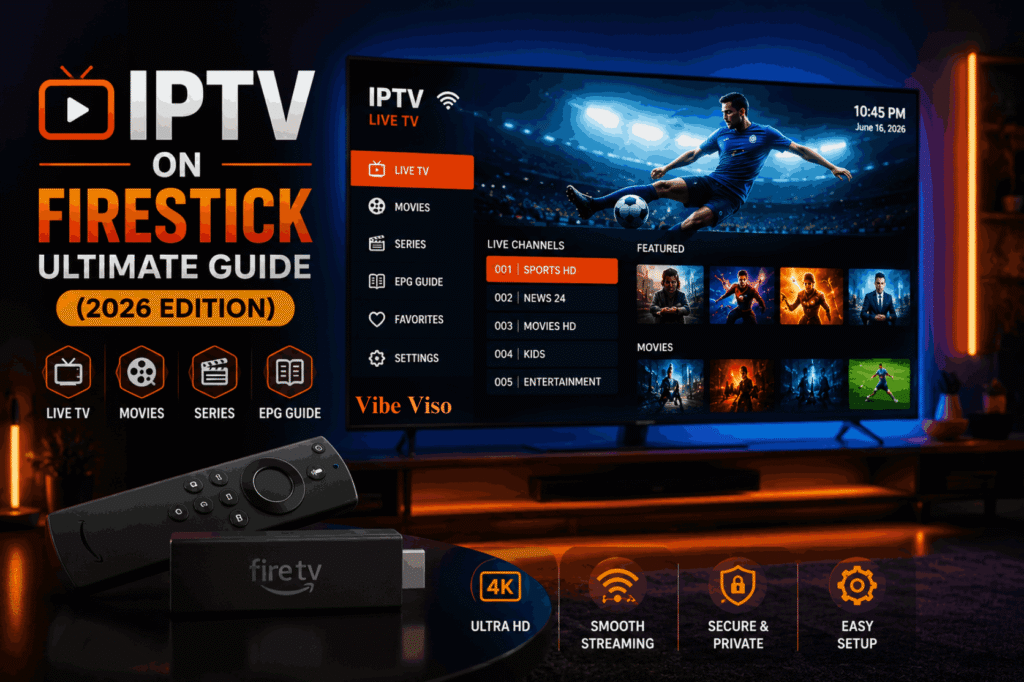
Are you tired of paying massive monthly cable bills? It’s time to cut the cord. In 2026, the way we watch Live TV and Video on Demand (VOD) has shifted significantly. With the introduction of Amazon’s new Vega OS, many users are finding it harder than ever to get IPTV on Firestick running smoothly. Whether you are searching for the best IPTV Firestick setup or need a reliable IPTV Fire TV Stick installation guide, you have come to the right place. This guide is your ultimate roadmap to installing a top-tier IPTV App on your Amazon Fire TV Stick while ensuring a professional, zero-buffering experience—no matter which streaming device model you own. CRITICAL WARNING: Fire OS vs Vega OS in 2026 If your new device runs Vega OS instead of the traditional Fire OS, your ability to sideload third-party IPTV apps will be strictly restricted. To ensure your IPTV on Firestick setup works, you must verify your Firestick OS version immediately, as Fire OS IPTV compatibility is currently superior to the newer, locked-down Vega environment. As an industry expert with 5 years of experience, I’ve seen this transition disrupt the Firestick IPTV landscape significantly. While Fire OS allows open-source flexibility for your favorite IPTV player, Vega OS is a Linux-based shift designed by Amazon to enhance performance but limit unauthorized APK installation. Understanding this distinction is vital for a seamless IPTV streaming experience in 2026. Why some new Firesticks block IPTV apps (Vega OS explained) New devices using Vega OS block IPTV apps because they lack the Android-based framework required for standard sideloading. Unlike the older Fire OS versions that allowed APK installation from “Unknown Sources” via the Downloader App, Vega OS enforces strict security protocols that prevent the execution of third-party IPTV App files not found in the official Amazon Appstore. The move toward Vega OS is essentially a move toward a “walled garden” ecosystem. In my experience, these app restrictions are meant to improve stability, but they effectively kill the versatility that made the Firestick a favorite for IPTV enthusiasts. If your device uses Vega, you won’t be able to bypass these security measures using standard sideloading techniques. How to identify your Firestick model and OS version To identify your device, navigate to Fire TV Settings > Device Information > About. Here, you can check your Firestick model and the current Firestick OS version. Devices like the Fire TV Stick 4K Max or Fire TV Cube provide different software paths, so always confirm your specific Fire TV settings to determine if you are running a compatible OS for IPTV usage. Knowing your specific hardware—whether it’s the Fire TV Stick Lite, Fire TV Stick HD, Fire TV Stick 4K, or the high-performance Fire TV Stick 4K Max—is critical. I always advise users to check the System Update menu after identifying the model, as software patches can sometimes change your underlying OS environment, affecting your IPTV compatibility. The best Firestick models to buy for IPTV in 2026 The Fire TV Stick 4K Max is currently the best Firestick for IPTV in 2026 due to its superior processing power, Wi-Fi 6 support, and ample storage for high-quality streaming performance. While the Fire TV Stick 4K or standard Fire TV Stick HD are viable, the 4K Max ensures the best playback for Dolby Vision and HDR10 content, minimizing the hardware bottlenecks often seen in the Fire TV Stick Lite. In my 5 years as an IPTV provider, I’ve learned that hardware matters just as much as the service itself. A device with a faster processor handles heavy IPTV app interfaces and large EPG files with ease. For the best long-term results, invest in a model that won’t lag when decoding high-bitrate streams, ensuring your Firestick IPTV setup remains future-proof. The “Pre-Flight” Checklist Before Using IPTV on Firestick Before beginning your IPTV setup, you must verify three critical pillars: a minimum stable internet speed of 25 Mbps, a reliable IPTV subscription supporting Xtream Codes API, and a secure environment to avoid IPTV malware. Skipping this IPTV setup checklist often leads to common issues like buffering and account suspension. As an industry expert, I’ve seen many users jump straight into installation, only to face endless technical glitches. Proper IPTV preparation isn’t just about software; it’s about ensuring your home network and provider choices are robust enough to handle high-definition content without compromising your data privacy. Internet speed reality check To maintain a high-quality stream, you need a minimum of 25 Mbps download speed. You can verify your connection using Fast.com to detect potential ISP throttling. If your speed test shows consistent fluctuations or low bandwidth, your IPTV streaming experience will suffer from persistent buffering, regardless of your chosen IPTV player. Many users mistake their “advertised” speed for their “actual” streaming speed. I always advise running a speed test during peak usage hours. If your Internet Service Provider (ISP) is actively practicing bandwidth shaping, you’ll notice a significant drop in latency and quality. Using a high-quality VPN can often bypass this throttling, ensuring you get the performance you pay for. Choosing the right provider: Xtream Codes API vs. M3U playlists Xtream Codes API is vastly superior to standard M3U playlists for Firestick users because it offers faster authentication, automated EPG (Electronic Program Guide) integration, and more reliable VOD (Video on Demand) organization. While an M3U playlist is essentially a static file, the API allows for dynamic updates without re-entering long, complex playlist URLs. If you are struggling to source a high-quality list, check our guide on finding a stable M3U playlist to ensure your streaming library is both active and buffer-free. In my 5 years of providing IPTV solutions, I always recommend Xtream Codes API as the primary IPTV login method. M3U links are prone to breaking and are often clunky to manage, especially when dealing with large libraries. The API implementation in modern apps like TiviMate allows for a snappier, “cable-like” experience that M3U files simply cannot replicate. The hidden dangers of “Free”
How Does IPTV Work? Technology Explained Simply
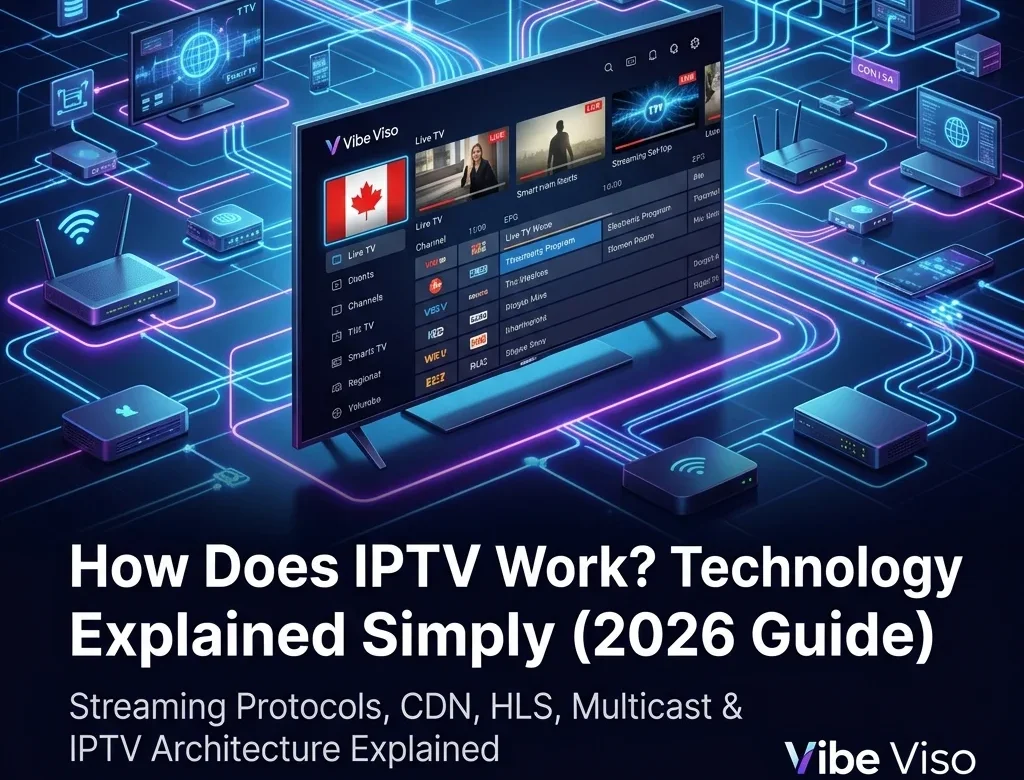
How Does IPTV Work? Technology Explained Simply IPTV (Internet Protocol Television) works by distributing television programming as digital data packets over standard Internet Protocol (IP) networks using a packet-switched, pull-based delivery model. Unlike traditional cable or satellite systems that continuously broadcast all channels simultaneously over radio frequency (RF) signals, an IPTV network only transmits the specific stream requested by the client device. The delivery pipeline operates in four major phases: Acquisition & Encoding: Raw feeds are ingested from satellites or fiber links and compressed using video codecs like H.264, H.265 (HEVC), or AV1. Packaging: Compressed video and audio streams are encapsulated into containers—MPEG-TS for live broadcasts or fragmented MP4 (fMP4) for on-demand media—alongside dynamic manifest index files (M3U8 for HLS or MPD for DASH). Distribution: Streams are cached on regional Content Delivery Network (CDN) edge nodes. Live TV is routed across private ISP networks via IP Multicast using IGMPv3 protocols to conserve bandwidth, while Video-on-Demand (VOD) uses IP Unicast connections. Playback: The client player parses the manifest, employs Adaptive Bitrate (ABR) heuristics to dynamically switch resolutions based on bandwidth fluctuations, and utilizes the device’s hardware SoC to decode and display the video. What Is IPTV and How Does It Work? Internet Protocol Television (IPTV) is the delivery of television content over IP-based networks rather than traditional terrestrial, satellite, or cable formats. Traditional cable TV broadcasts the entire frequency spectrum down physical lines, forcing the receiver to filter a single channel. In contrast, IPTV is a pull-based media system where the network routes only the specific stream requested by the client device. This selective delivery model optimizes network bandwidth and supports interactive services like timeshifted television and network-based recording. Modern architectures utilize a hybrid model: live feeds are broadcast via IP Multicast to conserve backbone bandwidth, while Video-on-Demand (VoD) and catch-up services are delivered via IP Unicast to individual subscribers. For more context on adoption trends, see what is IPTV. IPTV vs. OTT vs. Cable/Satellite Comparison To understand why IPTV is structurally different from standard streaming services and traditional television, review the primary architectural differences: Feature IPTV (Managed Network) OTT (Public Internet) Cable/Satellite (RF Coaxial/Dish) Delivery Medium Private, operator-managed IP network (VLAN-isolated) Public internet (best-effort delivery) Dedicated radio frequency (RF) spectrum End-to-End Latency Very low (1–3 seconds via UDP multicast) Moderate-to-high (6–18 seconds via HTTP unicast) Lowest (sub-second broadcast delay) Quality of Service (QoS) Yes (enforced by network priority queues) No (vulnerable to network congestion) Physical isolation prevents interference Bandwidth Impact Zero impact on general internet traffic (multicast) Competes with other local network downloads Direct transmission; burns zero LAN bandwidth Primary Use Cases Live telco television services (Bell Fibe, Telus Optik) Web-based video apps (Netflix, YouTube, RiverTV) Standard residential cable bundles and dish receivers The end-to-end IPTV pipeline follows this path: Each stage of the pipeline plays a specific role in maintaining stream flow: Content Source: Ingestion point for raw signals from direct fiber links, satellite downlinks, terrestrial broadcasts, or cameras. Encoder: Compresses raw baseband video into digital formats using H.264 (AVC) or H.265 (HEVC) codecs. Transcoder: Converts the encoded stream into multiple resolution and bitrate profiles, creating an Adaptive Bitrate (ABR) ladder to handle variable connection speeds. Packager: Encapsulates transcoded streams into delivery containers (like HLS .m3u8 or DASH .mpd segments, or MPEG-TS for multicast). Origin Server: The central repository hosting packaged media chunks and manifests, serving as the source for CDN pulls. CDN Edge: Distributed caching servers colocated at regional ISP Points of Presence (POPs) that intercept viewer requests locally to reduce latency. To learn which services utilize Canadian POPs, see best IPTV services across Canada. ISP Network: Transit infrastructure routing IP packets over fiber backbones, using DSCP tags for video packet prioritization. Home Router: Customer-premises gateway routing packets to decoders and using IGMP snooping to prevent local network flooding. IPTV Player: Client software parsing manifests, fetching chunks, managing a jitter buffer, and handling DRM. For client setup guides, consult the IPTV setup guide or see how to install IPTV on Firestick in Canada. TV Display: Physical screen rendering decoded progressive frames via HDMI and playing synchronized audio. For cost comparisons, see IPTV pricing in Canada. How live TV reaches your screen: A step-by-step walkthrough To trace this pipeline, consider a live TSN sports broadcast of a soccer match. At the stadium, a 4K camera captures video at 60fps, sending uncompressed 12 Gbps baseband video via 12G-SDI to an Outside Broadcast (OB) van. The production team mixes the feed and encodes it into a 50 Mbps HEVC contribution stream, transiting it via Secure Reliable Transport (SRT) over fiber to the broadcast center. At the center, transcoders convert the feed into an ABR ladder (e.g., 1080p at 8 Mbps down to 480p at 1.5 Mbps). The packager segments the video into 2-second fragmented MP4 (fMP4) chunks, encrypts them via AES-128, and updates the HLS .m3u8 manifest. The origin server hosts these files, which are cached by local CDN edge nodes. When a viewer selects the channel, the IPTV player retrieves the .m3u8 manifest from the local CDN. Selecting the 1080p stream, the player pulls sequential segments over the ISP’s GPON fiber network. GPON technology delivers up to 2.4 Gbps downstream using Wavelength Division Multiplexing (WDM) to multiplex multiple customer ONT connections. The packets flow to the home router, and then over Ethernet to the Set-Top Box. The player deposits chunks into a 3-second jitter buffer, negotiates DRM licenses, decodes the HEVC stream using the SoC’s hardware decoder, and displays the video on the TV screen via HDMI. How IPTV Content Is Acquired: Ingest and Contribution IPTV content acquisition, also known as ingest or contribution, is the process of collecting source television feeds from satellites, terrestrial antennas, local hardware interfaces, and live IP links, and routing them into the IPTV headend for processing. The reliability and fidelity of the IPTV service are bounded by this acquisition layer. Satellite feeds (DVB-S/S2) Satellite downlinks remain a primary source for linear ingest. Raw C-band (3.7–4.2 GHz) or Ku-band (11.7–12.7 GHz) signals are received by geostationary satellite dishes. At the dish’s focal point, a Low-Noise Block downconverter (LNB) amplifies the weak
What Is IPTV? The Complete Guide for Canadian Viewers (2026)
What Is IPTV? The Complete Guide for Canadian Viewers (2026) – CRTC Rules, Legal Risks & Setup Guide IPTV stands for Internet Protocol Television. It is a technology that transmits live television broadcasts and on-demand video over a broadband internet connection—using the exact same internet data packets that load websites or play YouTube videos. Unlike traditional cable TV, which requires a dedicated coaxial cable line, or satellite TV, which requires a physical dish antenna pointed at the sky, IPTV only requires a stable internet connection and a compatible player app or set-top box. In Canada, IPTV providers must be registered with the CRTC or follow strict exemption rules to distribute content legally. If you have ever watched live programming on CBC Gem, caught a hockey game on Sportsnet+, or logged into a streaming TV app on your phone, you have already used IPTV. Over the past decade, television delivery has undergone a quiet transition. Traditional TV networks are dismantling their analog broadcast towers and coaxial copper networks, migrating the entire infrastructure to internet-based transmission. For Canadian consumers, this shift represents both an opportunity and a source of confusion.The opportunity is obvious: cutting the cord and switching to internet-based television can save the average Canadian household over $100 per month. The confusion stems from the emergence of thousands of low-cost online services advertising claims such as “15,000 live channels for $10 a month” alongside legitimate providers like Bell Fibe TV, Rogers Xfinity TV, RiverTV, and VMedia.. Understanding the Canadian IPTV landscape in 2026 requires looking past user interfaces. The difference between a legal, licensed service and an unauthorized, grey-market stream lies in the regulatory compliance under Canada’s Broadcasting Act, licensing agreements with copyright owners, and the technical delivery systems operating behind the scenes. This guide is written to help you understand how the technology works, navigate the legal landscape, troubleshoot playback issues, and set up a compliant media player. 💬 People Also Ask: What does IPTV stand for? IPTV stands for Internet Protocol Television, which is the delivery of television content over IP networks. This contrasts with delivery through traditional terrestrial, satellite, and cable television formats. What Is IPTV? ⚡ Quick Answer: IPTV is the delivery of television programming over Internet Protocol (IP) networks. It works by transmitting encoded video streams in continuous data packets to specific IP addresses, rather than broadcasting all channels simultaneously over cable lines or satellite frequencies, allowing for high-definition, interactive, and multi-device viewing. To understand IPTV, it helps to compare it to the television formats that dominated the last half-century. Traditional cable and satellite systems use a continuous broadcast model. In a legacy coaxial cable network, the provider sends every channel’s signal down the wire to your home simultaneously. When you change channels on a traditional cable box, you are simply instructing the box to tune to a different frequency on the incoming line. This requires massive physical bandwidth and keeps you locked into a single physical location where the coaxial cable is terminated. IPTV, by contrast, only sends the channel you are actively watching. When you select a channel on an IPTV player, it sends a request back to the provider’s server. The server then initiates a unicast or multicast stream of data packets directly to your device’s IP address. This package-based transmission model means IPTV can be accessed over any stable internet connection, on any compatible device, anywhere in Canada. The Three Core Components of an IPTV System The Ingestion and Encoding Headend: Broadcast satellite signals, live camera feeds, and pre-recorded video files are captured and compressed using modern video codecs (such as H.264, H.265/HEVC, or AV1). The Content Delivery Network (CDN): Geographically distributed networks of servers cache and replicate the encoded stream segments. When a viewer in Calgary selects a channel, the stream is delivered from a CDN edge node located within the city, minimizing latency and buffering. The Client-Side Player Application: An app installed on a smart TV, streaming stick, or computer (such as Vibe Viso, TiviMate, or Apple TV) receives the incoming data packets, reassembles them, decompresses the video, and renders it on screen in real-time. [Satellite / Live Feed] ──> [Encoding Headend] ──> [CDN Edge Server (Local City)] ──> [ISP Gateway] ──> [Home Router] ──> [IPTV Player App] 💬 People Also Ask: Is IPTV the same as Netflix or standard streaming apps? While both transmit video over the internet, Netflix focuses almost entirely on pre-recorded Video-on-Demand (VOD) using asynchronous unicast streaming. IPTV specializes in delivering live, synchronized television broadcasts, complete with structured electronic program guides (EPG) and real-time channel switching. → Learn how Vibe Viso handles live stream playback — an advanced BYOM player optimized for high-bitrate live TV feeds. How Does IPTV Work in Canada? ⚡ Quick Answer: IPTV works by converting live TV signals into digital data packets, which are cached on local Canadian Content Delivery Networks (CDNs) and routed through ISPs using protocols like HLS or MPEG-DASH. Legal telecom services use managed multicast networks, while independent services use unicast over the public internet. To understand the difference in quality between various IPTV services, we must look at the two primary transmission architectures used to deliver streams to Canadian homes. Multicast Delivery vs. Unicast Streaming Managed Multicast IPTV (Telecom Networks) Major Canadian telecommunications companies (such as Bell with Fibe TV and Telus with Optik TV) deliver their television services over private, managed fiber-to-the-home (FTTH) networks using IP Multicast. This architecture relies on the Internet Group Management Protocol (IGMP, RFC 3376). In a multicast setup, the ISP sends a single video feed to a local network node. When your set-top box requests a channel, the local node replicates the feed to your specific port. This prevents the ISP’s network backbone from becoming congested, as a million viewers watching a hockey game only consume the bandwidth of a single stream on the main transmission line. WARNING If you use your own router behind a telecom gateway, you must enable IGMP Snooping in your router’s LAN settings. Without IGMP Snooping, the router treats multicast stream packets as broadcast packets, sending them
Playlist for IPTV | Best Setup Methods for All Devices 2026
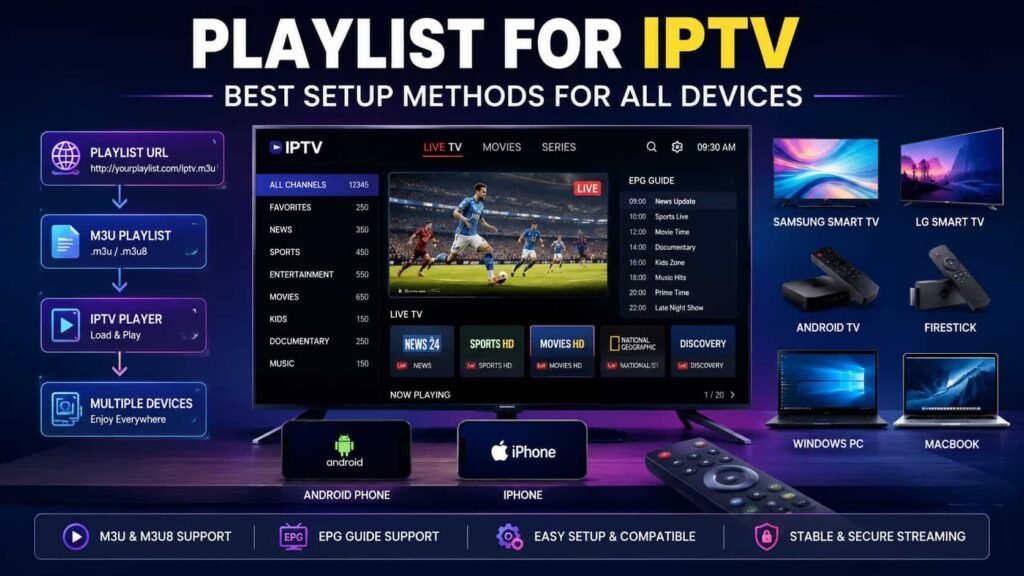
Looking for the best Playlist for IPTV to enjoy seamless live TV streaming? Whether you’re new to IPTV or searching for a better way to manage channels, understanding how an M3U playlist, Playlist URL, and EPG work together is essential for a smooth viewing experience. A well-configured Playlist for IPTV helps organize channels, improve loading speed, and simplify access across multiple devices using a compatible IPTV Player. In this guide, you’ll learn everything from playlist setup and management to optimization and security best practices. If you’re in Canada and looking for a reliable streaming solution, Vibe Viso can help you get the most out of your IPTV experience. What Is a Playlist for IPTV? A Playlist for IPTV is a file or URL that contains a collection of streaming sources used by an IPTV player to access live TV channels, movies, series, and other media content. It acts as a digital channel directory, helping the player locate and organize streams for seamless playback across supported devices. Understanding a playlist for IPTV is essential because it serves as the foundation of every IPTV service. Whether you use a local playlist file or a remote playlist URL, the playlist tells the IPTV player where to find media streams and how to display them properly. Without a valid playlist, an IPTV player cannot load channels, categories, or video content. What Does a Playlist for IPTV Mean? A playlist for IPTV refers to a structured collection of streaming links that an IPTV player reads to display channels and media content. It works as a roadmap that connects users to live TV, video-on-demand libraries, and internet-based television streams through organized channel listings. In simple terms, an IPTV playlist contains the information required to access and organize media streams. Most IPTV services provide playlists in M3U playlist or M3U8 playlist formats because these formats are widely supported across different IPTV applications and streaming devices. As IPTV providers, we often explain to users that the playlist itself does not contain the video content. Instead, it contains references to streaming locations, making it easier for an IPTV player to retrieve and play content instantly. How Does an IPTV Playlist Work? An IPTV playlist works by providing a list of streaming URLs that an IPTV player reads and converts into a usable channel interface. The player scans the playlist, identifies available channels, groups content into categories, and then connects users to the appropriate media streams when selected. When a user imports a playlist URL for IPTV or uploads a playlist file, the IPTV player processes the data and builds a channel directory. The system then fetches information such as channel names, logos, categories, and stream locations. The process typically follows these steps: User adds an IPTV playlist. IPTV player reads playlist data. Channel information is extracted. Streaming URLs are validated. Channels are displayed inside the app. Users select content and begin streaming. A properly configured IPTV playlist setup ensures faster loading, better organization, and improved playback stability. Why Does Every IPTV Player Need a Playlist? Every IPTV player requires a playlist because it provides the channel and stream information necessary for content playback. Without a playlist, the player has no source data to identify available channels, organize content, or connect to streaming servers. Think of an IPTV player as a media reader. The player itself does not provide channels. Instead, it depends on an external playlist source to access content. A playlist enables the player to: Load live TV channels Organize categories automatically Display channel names and logos Access VOD content Refresh updated streams Manage channel lists efficiently This is why successful IPTV playlist configuration is one of the most important steps when setting up any IPTV service. From our experience managing IPTV services for Canadian viewers, many playback issues occur because users upload an incorrect playlist or use an outdated playlist URL. A properly maintained playlist significantly improves the overall viewing experience. What Information Is Stored Inside an IPTV Playlist? An IPTV playlist file stores channel information, streaming URLs, media metadata, category details, and playback instructions. These details help IPTV players identify content, organize channels, and connect viewers to the correct streaming sources. A standard media playlist may contain: Playlist Element Purpose Channel Name Identifies the TV channel Streaming URL Direct link to the media stream Channel Logo Displays channel branding Group Category Organizes channels into sections TV Guide Data Supports EPG integration Media Metadata Provides content information Stream Format Defines playback compatibility Most modern IPTV services use an M3U playlist for IPTV because it supports all essential metadata while remaining lightweight and highly compatible. Common playlist formats include: M3U Playlist M3U8 Playlist Remote Playlist URL Local Playlist File Stream Playlist Live TV Playlist Internet TV Playlist For long-term stability, IPTV users should regularly review their IPTV playlist management, update expired streaming links, and verify playlist compatibility across devices. Proper playlist maintenance helps reduce loading issues, buffering problems, and channel availability errors. A well-structured playlist for IPTV acts as the backbone of the entire streaming experience, ensuring channels load correctly, categories remain organized, and content stays accessible whenever users want to watch their favorite programs. IPTV Playlist Basics You Should Know Before using any IPTV service, it is important to understand the basics of an IPTV playlist, including its structure, formats, and delivery methods. A properly configured playlist helps IPTV players organize channels, load streams efficiently, maintain compatibility across devices, and provide a smooth viewing experience. Whether you are following an IPTV playlist setup guide, learning IPTV configuration, or comparing different playlist formats, understanding these fundamentals helps prevent loading errors, playback issues, and channel management problems. For Canadian IPTV users, proper playlist organization can significantly improve streaming stability and user experience. IPTV Playlist Structure The IPTV playlist structure is the framework that organizes channel information, streaming links, metadata, and playback instructions inside a playlist. This structure allows IPTV players to identify channels, group content into categories, and connect users to the correct media streams quickly and efficiently.
Ultimate IPTV Configuration Guide for Beginners | Vibe Viso
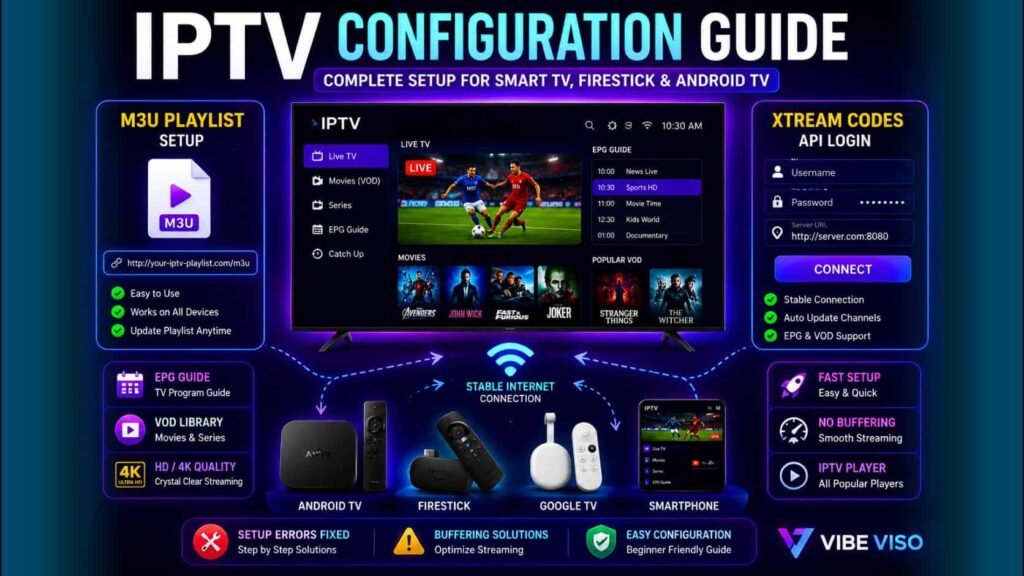
Are you looking for a reliable IPTV Configuration Guide to set up your streaming service without errors or buffering issues? This Complete IPTV Configuration Guide covers everything you need to know, from adding an M3U Playlist or Xtream Codes API to configuring EPG and VOD on your favorite IPTV Player. Whether you use a Smart TV, Android TV, Fire TV Stick, Google TV, or another Streaming Device, this step-by-step IPTV Configuration Guide will help you achieve smooth performance. You’ll also learn how IPTV Smarters Pro, TiviMate, and XCIPTV work with a stable Internet Connection and Quality IPTV Subscription. If you’re searching for the best IPTV for Canada football matches, this IPTV Setup and Configuration Guide from Vibe Viso provides the essential setup tips for an uninterrupted viewing experience. What Is IPTV Configuration and Why Does It Matter? The IPTV Configuration Guide explains how to properly connect an IPTV service to an IPTV Player, configure the required settings, and establish a stable Internet Connection on a compatible Streaming Device. Proper configuration is essential because it directly affects channel loading speed, streaming stability, playback quality, and the overall user experience. The complete IPTV configuration process explained includes entering login credentials, adding playlists, connecting servers, and optimizing player settings. Whether you follow an IPTV Setup Guide, IPTV Installation Guide, IPTV Configuration Tutorial, or IPTV Setup Step by Step resource, the goal remains the same: ensuring reliable and uninterrupted streaming. For beginners, a Beginner’s Guide to IPTV Configuration helps simplify the setup process and reduces common mistakes that can lead to connection failures or poor performance. Understanding how IPTV configuration works is important because every setting influences how content is delivered to your device. A properly configured IPTV service creates a smoother viewing experience, faster channel switching, and better compatibility across multiple devices. That is why every IPTV Setup and Configuration Guide considers configuration one of the most important steps before streaming begins. IPTV configuration becomes easier when you first understand how IPTV technology works. How Does IPTV Configuration Affect Streaming Quality? IPTV configuration directly impacts video quality, channel stability, loading speed, and buffering frequency. The best IPTV configuration for smooth streaming ensures that your Internet Connection, player settings, and server credentials work together efficiently to deliver consistent HD and 4K streams. Many users ask how IPTV configuration affects streaming because even premium services can perform poorly when settings are incorrect. A properly configured IPTV Player can improve playback responsiveness and reduce interruptions during live sports and entertainment streams. An effective IPTV streaming quality optimization guide focuses on selecting the correct playback settings, maintaining a stable network, and using a reliable Streaming Device. These factors help ensure smooth content delivery from the IPTV server to the viewer. Understanding how to avoid buffering during IPTV configuration is especially important for football fans watching major events. Incorrect player settings, unstable internet connections, or incomplete setup procedures can increase buffering and reduce picture quality. Proper configuration minimizes these issues and creates a more reliable streaming experience. How Do You Configure IPTV Step by Step? A proper IPTV Configuration Guide starts with choosing a valid IPTV Subscription, installing a compatible IPTV Player, entering login credentials, loading playlists, configuring the EPG, and testing playback quality. Following a structured Beginner IPTV Setup and Configuration Guide helps users complete the setup correctly, even without technical knowledge. When people search for how to configure IPTV step by step, they usually want a simple process that works across different devices. In real-world testing, most setup issues occur because users skip a step, enter incorrect credentials, or use an unsupported player. A practical Complete IPTV Configuration Guide for Beginners typically follows these stages: IPTV Configuration Checklist for Beginners Verify your active IPTV Subscription. Prepare a stable Internet Connection. Install a trusted IPTV Player such as IPTV Smarters Pro, TiviMate, or XCIPTV. Obtain your M3U Playlist URL or Xtream Codes API credentials. Configure the player correctly. Load the EPG for channel schedules. Test live TV, sports channels, and VOD content. Optimize playback settings for your device. This IPTV Configuration Process for Beginners is similar whether you use a Smart TV, Android TV, Google TV, Fire TV Stick, Streaming Device, smartphone, tablet, or desktop computer. Step 1: Install a Compatible IPTV Player The first step in any IPTV Installation and configuration process is selecting a reliable player. Different players offer different levels of performance and customization. IPTV Player Best For IPTV Smarters Pro Easy setup for beginners TiviMate Advanced customization and sports streaming XCIPTV Lightweight and user-friendly experience In practice, many first-time users find IPTV Smarters Pro easier to configure, while experienced users often prefer TiviMate for its advanced playback and EPG features. Step 2: Add Your IPTV Login Credentials After installation, enter the credentials provided by your IPTV provider. Most services use one of these methods: M3U Playlist URL Xtream Codes API Username Password Server URL This stage is often where configuration errors occur. A single missing character in the server address can prevent channels from loading correctly. Step 3: Configure EPG and Content Categories Once channels load successfully, configure the EPG. The EPG provides channel schedules, match times, program information, and event listings. For sports fans, a properly configured EPG makes it easier to follow football matches, tournament schedules, and live event coverage without manually searching for channels. Step 4: Test Streaming Performance A professional IPTV Configuration Tutorial should always include testing. Check: Channel loading speed HD and 4K playback quality Audio synchronization EPG accuracy VOD functionality Device responsiveness A setup should not be considered complete until these tests pass successfully. Step 5: Optimize for Long-Term Stability Many users think installation is the final step. In reality, long-term performance depends on optimization. Recommended practices: Use wired Ethernet when possible. Maintain a fast and stable Internet Connection. Keep your IPTV Player updated. Clear cache periodically. Restart your Streaming Device after major updates. These small adjustments often have a greater impact on viewing quality than users expect. What Information Do You Need Before Configuring IPTV?