
IPTV vs OTT: Core Technical Differences Explained
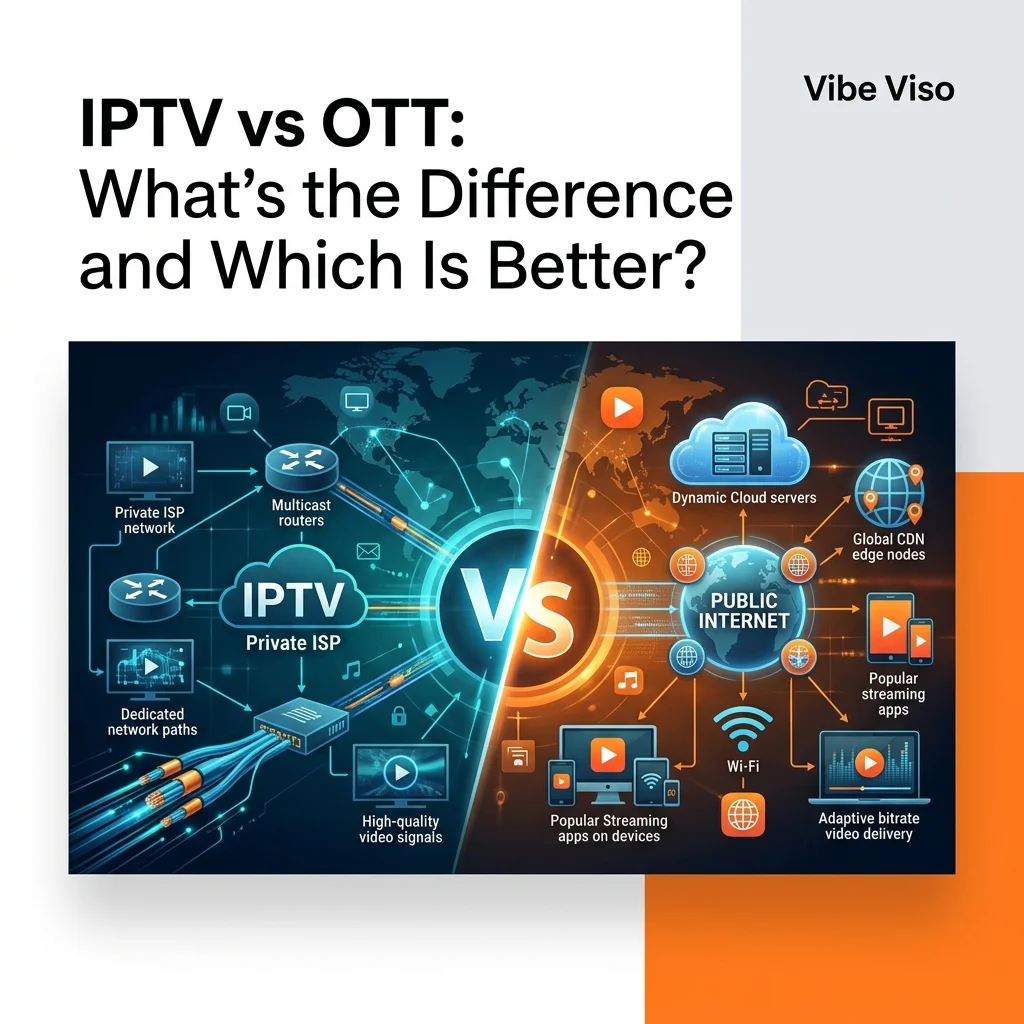
IPTV vs. OTT: What’s the Difference and Which Is Better? The primary difference between IPTV (Internet Protocol Television) and OTT (Over-the-Top) streaming is the delivery network. IPTV is transmitted over a private, closed, managed network owned by an ISP with guaranteed Quality of Service (QoS) priorities, whereas OTT is delivered over the public, unmanaged internet on a best-effort basis. IPTV is better for viewers who want a reliable, zero-buffer, real-time live television experience (such as live sports), while OTT is better for viewers prioritizing on-demand libraries, global mobility, and device flexibility. What Is the Main Difference Between IPTV and OTT? The primary difference between IPTV and OTT is the delivery network: IPTV is transmitted over a private, closed, managed IP network with guaranteed quality of service (QoS), whereas OTT is delivered over the public, unmanaged internet on a best-effort basis. To understand how IPTV works in practice, we must look beyond user interfaces. Both stream video over IP but rely on entirely different network topologies, routing protocols, and buffering designs. For a broader overview of the technology, check our deep-dive into IPTV technology. Overview Comparison Matrix The table below contrasts the technical architectures and operational parameters of IPTV and OTT networks. Comparison Dimension IPTV (Internet Protocol Television) OTT (Over-the-Top) Delivery Network Private, closed, managed IP network (telecom operator intranet) Public, unmanaged internet Transmission Model Multicast (one-to-many via IGMP) and unicast (one-to-one for VOD) Unicast (one-to-one pull model via CDN edge) Primary Protocols IGMPv2/v3, UDP, RTP, RTSP, MPEG-TS HTTP, HTTPS, TCP, HLS (m3u8), MPEG-DASH (mpd) Bandwidth Scaling Highly efficient multicast (O(1)O(1) scaling for live feeds) Linear unicast (O(N)O(N) scaling; each device requires a dedicated stream) Quality of Service (QoS) Guaranteed QoS (Layer 2/3 prioritization via VLAN and DiffServ DSCP tags) Best-effort delivery (QoE-driven; subject to network congestion and packet drops) Buffering Strategy Ultra-low client-side buffer (sub-second or a few frames of video) Adaptive client-side buffer (10 to 30 seconds of pre-downloaded video segments) Live Latency Low latency (typically 1 to 3 seconds, matching traditional broadcast television) High to moderate latency (10 to 30 seconds, reduced to 2 to 5 seconds with LL-HLS) DRM Mechanisms Conditional Access Systems (CAS) and hardware-integrated hybrid DRM Multi-DRM (Widevine, FairPlay, PlayReady) with software/hardware enclaves Geographic Mobility Restricted to the physical footprint and line drops of the managing ISP Global mobility (accessible from any active public internet connection) Defining IPTV: Infrastructure-Level Managed Delivery At its simplest, what is IPTV is like a private municipal utility. It delivers television services over a closed, private network owned and operated entirely by your telecommunications provider or Internet Service Provider (ISP). NOTE Real-World Analogy: Think of IPTV as a private municipal water main. The water utility company installs a dedicated, pressurized pipeline directly from the treatment plant to your home. This pipeline is used exclusively for clean water. Regardless of how congested the public roads are, or how heavily the public sewer systems are being loaded, your clean water pressure remains constant and guaranteed. The system is closed, controlled, and protected from end to end. To deliver this quality, the ISP partitions dedicated physical bandwidth for video. This Layer 2 isolation maps general internet traffic to VLAN 35 and IPTV traffic to VLAN 36 to prevent domestic bandwidth competition. Because physical bandwidth is reserved on the line, video quality remains constant. IPTV systems allocate a constant 5 Mbps for HD 1080p and 25 Mbps for 4K UHD streams. Video streams run flawlessly even during heavy household internet usage because of this physical bandwidth isolation. Within the operator’s core layers, strict Quality of Service (QoS) guarantees are enforced. Routers prioritize video packets tagged with DSCP markers like Expedited Forwarding (EF) or CS4/CS5 to eliminate packet drops and jitter. For live channel broadcasts, IPTV uses IP Multicast. Instead of transmitting separate streams, the source sends a single packet stream down the network. Routers duplicate packets via PIM-SSM routing only to active paths. Set-top boxes (STBs) use IGMP to join and leave multicast groups, while Video on Demand (VOD) uses unicast sessions managed by RTSP over UDP/RTP. Defining OTT: Over-the-Top Public Web Distribution In simple terms, Over-the-Top (OTT) is like using a public courier service. It delivers video, audio, and other media directly to your screen over the public, shared internet, bypassing closed cable, satellite, and ISP network controls. TIP Real-World Analogy: Think of OTT as ordering packages from an online store that uses the public postal service. Your packages are transported on public roads and highways, sharing the same lanes with delivery trucks, passenger cars, and commuter buses. If a traffic jam occurs on the highway, your package is delayed. To minimize the impact, the store sends the items in multiple small boxes. If the mail carrier notices a backup, they might deliver a lighter, smaller package to ensure it gets to you on time, even if it is not the full-sized item you wanted first. Because OTT services run as application-layer platforms, they cannot enforce physical network priorities. Instead, they use a client-pull model over Content Delivery Networks (CDNs) and Adaptive Bitrate Streaming (ABR) to cope with congestion. OTT requires at least 5 Mbps of free bandwidth for HD 1080p and 25 Mbps for 4K UHD. You can measure your current internet speed to verify if your line supports these requirements. Unlike IPTV, this bandwidth is not reserved. Other domestic web activity can drop available bandwidth, forcing the player’s ABR engine to downshift quality to avoid buffering. Since public networks do not route multicast, CDNs cache video files on edge servers near local ISPs. Players download index manifests (like HLS .m3u8 or DASH .mpd) or parse an M3U playlist referencing short segment chunks of 2 to 6 seconds. To learn the precise meaning of common terms, consult our IPTV glossary. The player’s adaptive heuristics evaluate network capacity and buffer levels in real time. During congestion, the player requests a lower-bitrate segment (e.g., from 1080p to 720p) to maintain playback continuity. Network Routing: RF Spectrum Filtering vs. Active IP Packet Routing Traditional cable and satellite TV rely on RF spectrum filtering, while modern IPTV and OTT use active IP packet routing. Traditional cable TV operates on